Wittenborg Annual Teachers’ Meeting 2026: AI, Gender Equality and Assessment Innovation
Agenda includes teaching delivery, assessment, AI integration and SDG focus
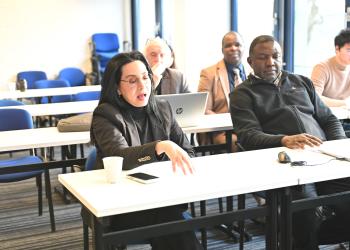
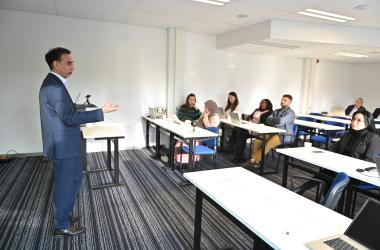
On 3 February, Wittenborg hosted its Annual Teachers’ Meeting, bringing faculty members together both in Apeldoorn and online. The session provided updates on teaching delivery, assessment strategies, year planning, and the institution’s focus on innovation, AI integration and gender equality, giving a clear view of what faculty are working on for 2026.
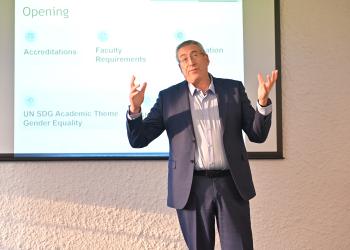
The meeting opened with a welcome from Head of the School of Business Rauf Abdul, who introduced new faculty members and outlined key discussion points, including accreditations, faculty requirements, the Globalisation Forum and AI policy. Abdul emphasised the institution’s commitment to excellence in teaching:
“We offer quality education. We do well in terms of curriculum design and development, delivery and assessment examinations, and we are currently being transformed by AI developments. All of us are continuously discussing how AI tools are reshaping higher education. We can deal with this challenge to stay relevant and effective and to develop the skills our graduates will need in the next five to ten years,” he said.
President Peter Birdsall followed, highlighting strategic priorities for the academic year and the institution’s focus on Sustainable Development Goals, with gender equality as this year’s theme.
“We don’t just want to align with SDGs for ourselves to feel good, but to introduce students to concepts that influence how we live and work together globally,” he said, urging faculty to weave the theme into their modules and student research where possible.
Teaching Delivery and Assessment
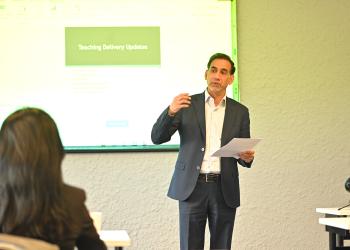
Abdul provided a detailed overview of teaching and assessment updates. He highlighted the institution’s ongoing efforts to refine curriculum, ensure sufficient learning resources, and support faculty development. He illustrated innovative approaches already in place, including certain modules, where students are encouraged to use generative AI tools as part of their assignments. The focus is on reflective thinking and personal commentary, rather than simply producing work, preparing students for industry expectations.
Globalisation Forum and Year Planning
The meeting also looked ahead to the Globalisation Forum, to be held as part of Project Week in October 2026. Faculty members are invited to submit papers or proposals for sessions, with a focus on student and staff participation.
Abdul emphasised that this initiative helps create a dynamic learning environment and supports the institution’s broader academic mission.
Faculty were also briefed on other key upcoming events for 2026, including the Staff and Student Representatives Conference on 24 February, the Annual Bowling Night on 20 February, the Professional Field Panel Meeting on 9 March, and the FIBAA NVAO Accreditation meeting on 8 to 9 June.
Workshop: Hands-On Strategies for 2026
Following the meeting, Birdsall led a workshop exploring practical approaches to AI integration.
A key focus of the session was prompt engineering, which Birdsall described as:
“Crafting prompts to get accurate, relevant outputs.”
He demonstrated how building prompts carefully, iterating, and refining instructions can improve productivity, creativity, and critical thinking when using generative AI tools. Birdsall explained that prompt engineering is not just about efficiency, but also about enhancing personalised learning:
“If students learn to build an A-frame into their Gen. AI, it will personalise their learning experience. The better you are at prompt engineering, the better you can use your tools, and the more it can support creativity and critical reflection.”
The workshop included interactive exercises where staff considered questions such as:
“What makes a good assessment at master’s level?” and “What do accreditation bodies care most about in programme documentation?”
Birdsall encouraged participants to first reflect independently before testing generative AI responses, illustrating how the combination of human insight and AI can improve assessment design.
The workshop also explored practical ways to incorporate gender equality discussions into modules and assessments. Staff shared ideas on home-based assessments, reflective assignments, and research opportunities that integrate SDGs into teaching without overloading students.
Birdsall announced an exciting new initiative:
“We will be offering a course in prompt engineering to students from the May block, which will be voluntary.” This course will give students hands-on experience in using generative AI effectively, combining creativity, critical thinking, and practical application to enhance both learning and assessment outcomes.
WUP13.02/2025
by Erene Roux
©WUAS Press
Tags