TourXpeRience Explores How VR Could Change the Way Tourism Students Learn
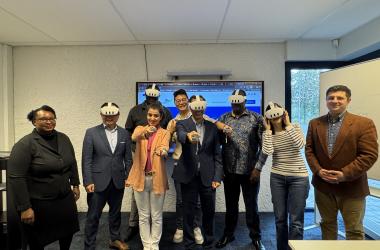
Teachers Complete XR Training Designed to Create More Immersive Learning Experiences
What if tourism students could practise handling a customer complaint, managing a travel disruption or making marketing decisions before ever entering the workplace?
That question was at the centre of the Erasmus+ TourXpeRience XR Teacher Training Programme, which recently concluded at Wittenborg.
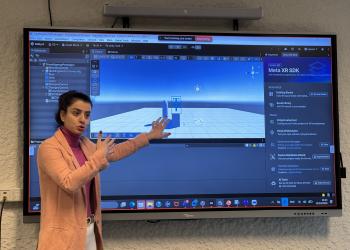
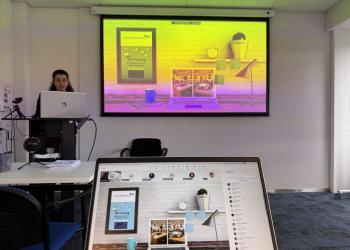
Over four sessions, around 15 educators per session explored how Extended Reality (XR) technologies, including Virtual Reality (VR), Augmented Reality (AR) and Mixed Reality (MR), can be used to create more engaging and practical learning experiences in tourism education.
The programme, led by Emmah Muchoki, Lecturer & Education Support, and Vajihe Shojaei, Assistant Professor of Applied Sciences, formed part of the wider TourXpeRience project, a European initiative focused on modernising vocational education and training in the tourism sector through immersive technologies.
Beyond the headset
While VR headsets and immersive environments may sound futuristic, the focus of the training was not technology alone. Instead, participants were encouraged to think about how XR can solve real classroom challenges and help students develop practical skills.
During one workshop, educators were asked to identify areas where students often struggle and consider whether immersive technology could offer a better learning experience.
“Think of a situation in your classroom where students struggle, or where they need more practical training,” Shojaei told participants.
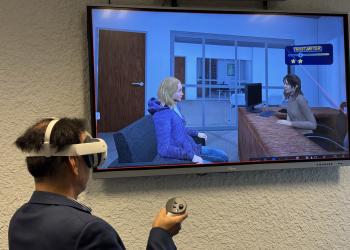
Rather than simply teaching concepts, educators explored how students could learn through experience. One example involved a virtual travel agency where students take on the role of a customer service representative dealing with an unhappy client. The choices students make influence how the scenario develops, creating a realistic environment in which mistakes become learning opportunities.
As participants discovered, effective XR learning starts long before the technology is switched on. Learning objectives, student roles, settings and decision-making moments all need to be carefully designed to create meaningful experiences.
“Not all learning objectives are suitable for XR,” Shojaei explained. “You need to think about whether the technology genuinely adds value.”
Rethinking the role of the teachers as educators
For Muchoki, one of the most interesting outcomes of the programme was the way participants reflected on their role as educators.
“I’m really pleased with how involved the teachers were with the idea of stepping back from giving learners the answers and instead guiding them towards the answers,” Muchoki added. “The discussion about being a facilitator rather than an instructor was a highlight for me during the workshop.”
The training took participants through a step-by-step process, beginning with the pedagogical value of XR technologies and ending with the design of their own XR-enhanced learning activities.
“We wanted teachers to go from simply using XR content to designing immersive learning themselves, and to feel confident doing it,” she said
By the final session, every participant had developed a first draft of an immersive learning activity that could be further developed in the next phase of the project.
Tackling real challenges
The programme also addressed a reality faced by many educational institutions: introducing new technology in teaching and learning is rarely straightforward.
“The teachers’ biggest worry was very practical: for example, how would you run an XR lesson with 24 students and only six headsets?” said Muchoki.
Discussions focused on practical solutions, classroom management and building confidence among educators who may be using XR technologies for the first time.
Another key takeaway was that successful adoption requires ongoing support.
“One workshop isn’t enough,” Muchoki said. “Teachers need ongoing training and regular chances to use XR and talk to each other about it, because the technology keeps changing and confidence only grows with practice.”
Preparing students for a changing industry
The wider TourXpeRience project aims to help vocational education keep pace with changes in the tourism sector through the use of XR technologies. For students, this could mean more interactive classes, realistic simulations and more opportunities to develop professional skills before entering the industry.
The journey continues on 4 November, when Muchoki and Shojaei will host another TourXpeRience VR training session in Apeldoorn.
WUP 26/10/2026
by Erene Roux
©WUAS Press
Tags