
Master’s Thesis Sheds Light on Differences Between Cinema and Streaming Experiences

Abdulkhaliq Farah’s Study Analyses Why Movie Theatres Still Matter in the Age of Streaming Platforms
For his master’s thesis in Digital Marketing & Communication, Wittenborg graduate Abdulkhaliq Farah set out to explore a question that resonates with audiences worldwide: why do people still go to the cinema when streaming is so convenient?
Titled ‘Comparing Cinema and Streaming Experiences: Insights from International Students Studying in Munich, Germany’, the research examined how international students perceive the experiential value of attending cinemas versus watching films on streaming platforms. Abdulkhaliq completed the study as part of his MBM in Digital Marketing & Communication at Wittenborg’s Munich study location, the New European College (NEC).
The study used Bernd Schmitt’s Strategic Experiential Modules (SEM) framework, which analyses experiences through five dimensions (Sense, Feel, Think, Act and Relate), to understand what drives audience choices in the digital age.
Through semi-structured interviews with eight international students living in Munich, the research explored how they decide between the two experiences. The findings revealed that while streaming dominates for its convenience, flexibility and control, movie theatres still deliver unique value through immersion, emotional engagement and social connection.
“I found that people go to the cinema when there’s what I called an experiential surplus,” Abdulkhaliq explains. “That means when the sensory, emotional or social experience outweighs the convenience of streaming. If a film offers big-screen immersion, like ‘Mission: Impossible’ or ‘Avatar’, people want to feel that intensity in a theatre. But if it’s a light comedy or documentary, they’d rather watch it comfortably at home,” he says.
Abdulkhaliq, who is originally from Somalia and grew up in the United Arab Emirates, said his passion for cinema shaped his choice of topic. “I’m purely a movie-theatre guy. Streaming is great for accessibility, but the cinema lets me be completely immersed in the art I’m watching,” the graduate points out.
He also notes that cinema outings can be meaningful social occasions. “Many of my interviewees said they enjoy going to the movies with friends. For them, it’s not only about the film but also about socialising: catching up before or after or just sharing the experience together. That was interesting to me, because I usually prefer going alone. I like to be fully immersed and escape from reality for those two hours.”
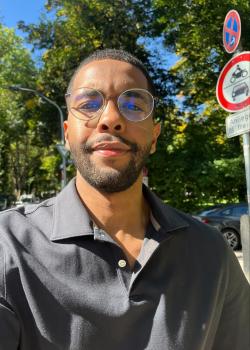
Cultural contrasts also caught his attention. “Back home in the Emirates, cinemas are always packed. Here in Germany, I realised people are more reserved and tend to prefer streaming. That contrast inspired me to explore the reasons behind it,” he says.
For Abdulkhaliq, adopting a qualitative research approach allowed for richer insights. “I chose interviews because they give depth. People could explain what makes a cinema trip memorable or why they prefer the freedom of streaming. It also gave me the chance to identify emotions and behaviours that wouldn’t show up in a quantitative survey.”
The thesis concludes that while streaming will likely continue to dominate viewing habits, cinema-going remains relevant as a social and sensory experience that technology cannot fully replicate. “Streaming gives control, but cinemas provide connection with others and with the story itself,” Abdulkhaliq summarises.
Reflecting on the process, he said he most enjoyed writing the final chapter, when the findings came together. “That’s when I could tell the full story. I had assumed most students would prefer cinemas, but it turned out many valued streaming because it feels more personal. It showed me that both experiences have their own kind of allure.”
Looking ahead, Abdulkhaliq hopes to pursue a career in branding and storytelling, applying the insights from his research. “Branding is all about how a product makes people feel, think and relate. My goal is to use that understanding to help brands connect with their audiences.”
He plans to stay in Germany for a while to gain professional experience before eventually returning to the UAE. “Germany has given me the chance to grow both academically and personally, but at some point, I’d like to take what I’ve learned back home.”
As for advice to future Wittenborg students working on their final projects, Abdulkhaliq recommends choosing the right research method and defining a clear problem. “Your method shapes your results. If I’d chosen a quantitative approach, I wouldn’t have uncovered the nuances that made this study special. And make sure you truly understand the problem you’re solving; that’s what gives meaning to your work.”
WUP 20/08/2026
by Ulisses Sawczuk
©WUAS Press
Tags
#SDG3: Good Health and Well-being
#Internationalisation
#Diversity
#highered
#research