
Davide Parrilli Challenges Students to Question AI, Ethics and 'Truth' in Data-Driven Business
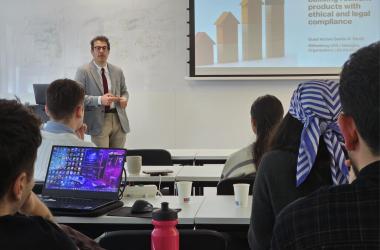
Guest Lecture Explores Data Ethics, AI and Why Critical Thinking Matters More Than Ever
Wittenborg’s BBA students attended a guest lecture on 2 April at the Amsterdam study location, featuring entrepreneur, lecturer and researcher Davide Parrilli, who explored the growing importance of data ethics in business, AI and digital society.
Held at the Dali Building, the session focused on how organisations can build resilient products and services while balancing ethical responsibility, legal compliance and technological innovation. Through case studies and interactive discussion, students were encouraged to think critically about how data-driven systems shape society and business decision-making.
Parrilli, who has a background in law, management and service design ethics, explained how his work combines data protection, compliance and ethical product design. Having worked for more than a decade in data protection and IT law, he now focuses on the intersection between regulation, ethics and innovation.
Question Everything
A central theme throughout the lecture was the importance of critical thinking in an era increasingly shaped by AI-generated information and digital platforms.
“Question everything,” Parrilli told students. “When we talk about ethics, critical thinking is essential.”
Using real-world examples, he encouraged students to think beyond legal compliance and consider the wider social consequences of data-driven technologies.
Case Studies and Ethical Decision-Making
The lecture used case-study learning to explore the ethical challenges surrounding large technology platforms. One example focused on a recent US court case involving Facebook, WhatsApp and Instagram and concerns around exposing young users to harmful content online.
Students were asked to place themselves in the position of a jury and consider not only the legal implications of the case, but also the ethical reasoning behind such decisions.
Parrilli introduced ethical frameworks including utilitarianism and deontology to help students analyse the case from multiple perspectives. Discussions also expanded into the differences between European and American approaches to regulation and digital responsibility.
AI, Deepfakes and the Future of Information
The discussion also explored how AI is changing the nature of data and information itself. Parrilli explained that AI systems are no longer only collecting data but are increasingly generating new forms of information, raising complex ethical questions around trust and truth.
“The fact that something is fake does not mean it has no impact,” he said, while discussing deepfakes and manipulated media. “If AI-generated content changes how people see reality, then it already affects society.”
He added that businesses and governments are still struggling to keep pace with the rapid development of AI technologies and their ethical implications.
Students Engage With Real-World Challenges
Parrilli described the session as highly interactive, with students actively contributing to discussions around ethics, AI and digital responsibility. He noted that many students already understand the risks linked to social media platforms because they engage with these technologies daily.
“The students had a good understanding of the challenges,” he said. “They know the context because they live in it.”
He also stressed the importance of using case studies in teaching, explaining that context helps students better understand complex ethical issues and business realities.
Preparing Students for Responsible Innovation
Alongside discussions on ethics and AI, Parrilli encouraged students interested in the field to stay informed and continuously engage with emerging research.
“Industry is still behind research in many areas of data ethics,” he explained. “Students who want to work in this field need to keep reading, studying and following how these technologies evolve.”
As AI continues to reshape industries and everyday life, the lecture challenged students to think not only about what technology can do, but also about what it should do.
WUP 10/06/2026
by Erene Roux
©WUAS Press
Tags